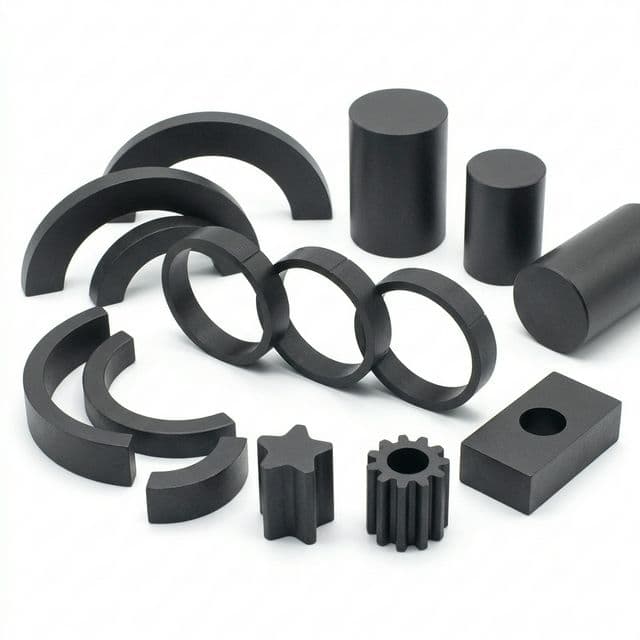
Compression vs injection bonding for custom magnet programs
A route-selection article focused on geometry, tooling, production stability, and the types of projects each process fits.
When a team compares compression bonding and injection bonding, the best choice usually depends on geometry, tooling logic, and the production path the program can realistically support.
Compression bonding in practice
Compression bonded magnets are often attractive when the project needs:
- Net-shape or near-net-shape parts
- Ring or arc geometries with tight packaging needs
- A route that favors compact assemblies and practical multipole execution
It is commonly discussed in motor and sensor applications where the part form matters as much as the material itself.
Injection bonding in practice
Injection bonding is often considered when:
- The program values molding flexibility around complex shapes
- Integrated part design or insert-based logic matters
- Tooling and production strategy support that route
In other words, the choice is not just about magnet material. It is about how the part will actually be made, assembled, and scaled.
Questions that make the comparison useful
Ask the supplier to frame the route around:
- Part geometry and wall thickness
- Expected production volume
- Tooling implications
- Magnetization pattern
- Assembly integration needs
Without those inputs, the compression versus injection discussion stays too abstract to guide a sourcing decision.
A practical takeaway
If the goal is to move quickly toward a viable route, focus on the total manufacturing picture:
- Which process suits the geometry better?
- Which route helps the assembly more?
- Which path keeps volume production practical?
That is the level where the comparison becomes commercially useful.
How to use this page for a real decision
Use the same sequence every time so route comparisons stay auditable and commercially useful.
Reviewed for manufacturability decision quality by BondedMagnetSource application engineering.
Inquiry email
Start inquiry opens your default email app.
Open email app can include a prepared subject if needed.
Author

Bonded Magnet Specialist
Technical Resources
Technical blog
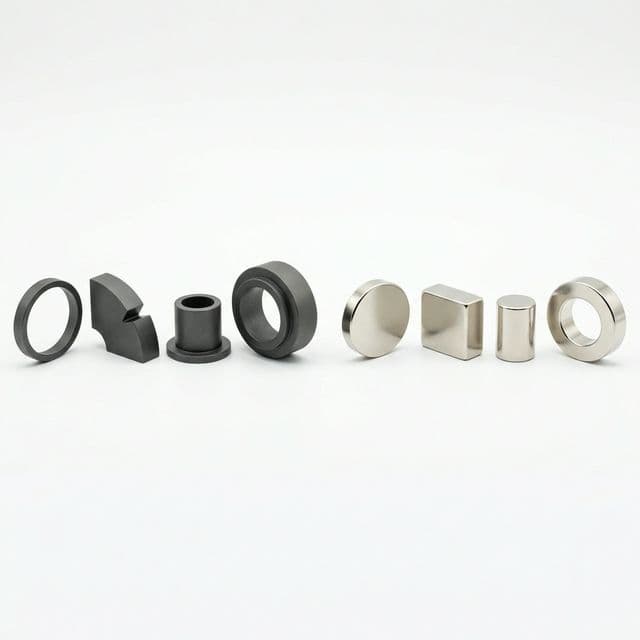
Bonded vs Sintered Magnets Differences: NdFeB decision report for geometry, assembly, risk, and cost
A source-backed decision report for teams comparing bonded ndfeb vs. sintered ndfeb and bonded vs sintered magnets differences under geometry freedom, magnetic output, thermal limits, and supply/compliance risk.

Bonded Magnets Market Update (2026-W15, Slot 1): Powder Floor Clauses, Flexible Scope Workflow, and Process Switch Triggers
A 30-day decision brief for OEM engineers and sourcing teams, translating March-April 2026 primary-source signals into bonded NdFeB and bonded ferrite RFQ, MOQ, lead-time, and process decisions.
Bonded Magnets Market Update (2026-W15, Slot 1): NdPr Floor Signals, Sm Route Expansion, and U.S. Scope Workflow
A decision-focused update for OEM engineers and sourcing teams on bonded NdFeB and bonded ferrite choices after March-April 2026 policy and supply-chain signals.